
PREMIUM: Deskilling Teachers Part 3
Making our work easier is good, actually.

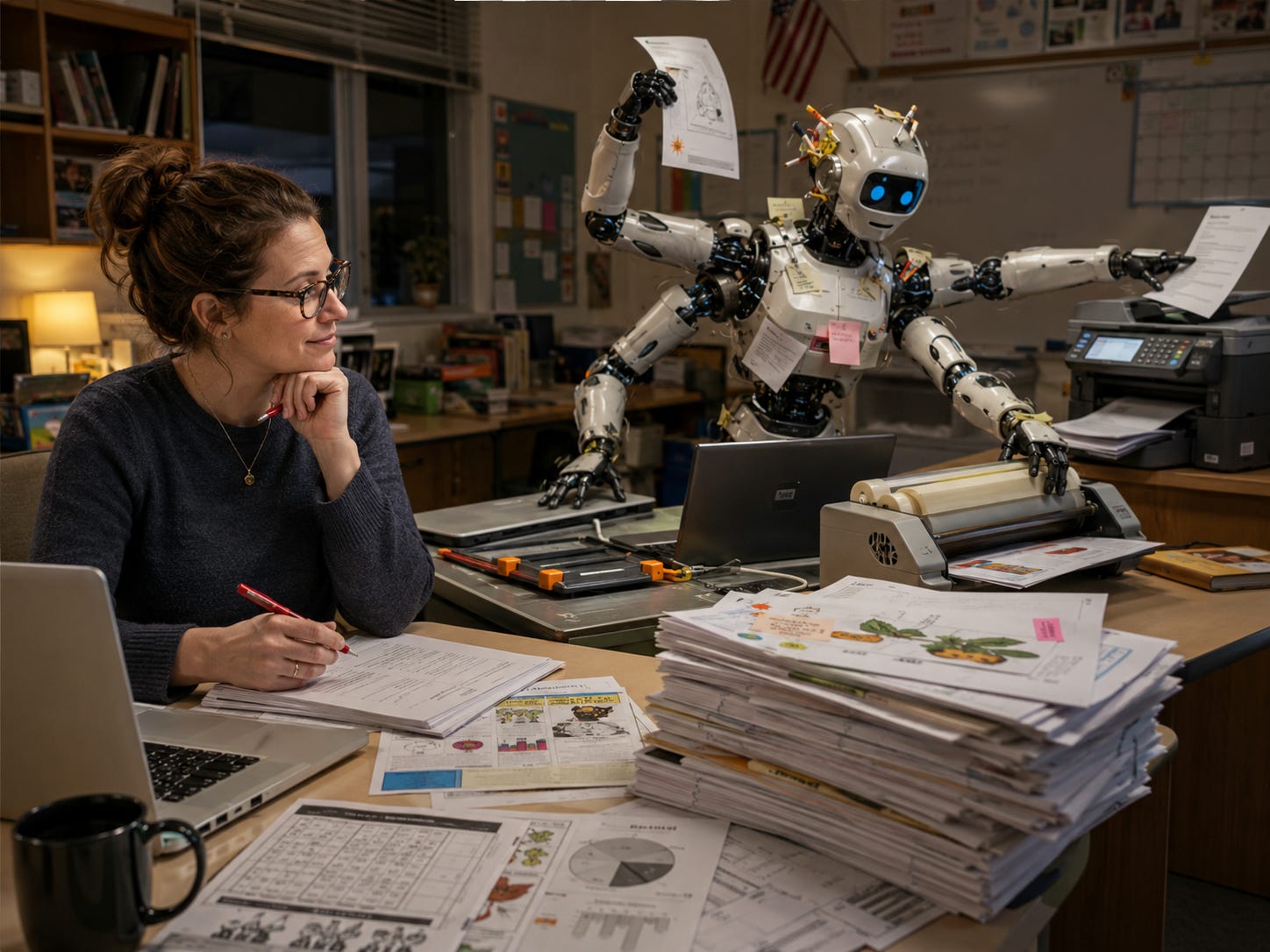
Back in February, I published the first two parts of a series of posts exploring whether teachers could be “deskilled” by resources, tools, and systems intended to help them.


In these posts, I acknowledged that the experience of teaching is useful for learning how to teach, because it provides valuable feedback. However, I argued that discovery learning was not an effective way to learn how to teach, and, in particular, we should not assume that high-workload and high-stress environments are useful or necessary for developing our skills as teachers.
I originally started writing this series after researchED Cambridge in October 2025. The initial prompt for the series was a talk about A.I. in education that raised the possibility that using generative A.I. would deskill teachers. The argument was that when we use A.I. for a task, it may be a form of “cognitive offloading”. This is where the use of A.I. means we don’t think and, therefore, don’t learn as much as we would by doing the same task without A.I. In this post, I will return to that topic. Much of this post was written (alongside Parts 1 and 2) back in October, and I’m not sure if it is consistent with what I wrote in my recent post about how I use ChatGPT to resource my lessons:

At the end of the post, I will discuss the extent to which my thinking has changed.
Keep reading with a 7-day free trial
Subscribe to Andrew Old's Education Battleground to keep reading this post and get 7 days of free access to the full post archives.