
Deskilling Teachers: Part 1
Making our work easier is good, actually.

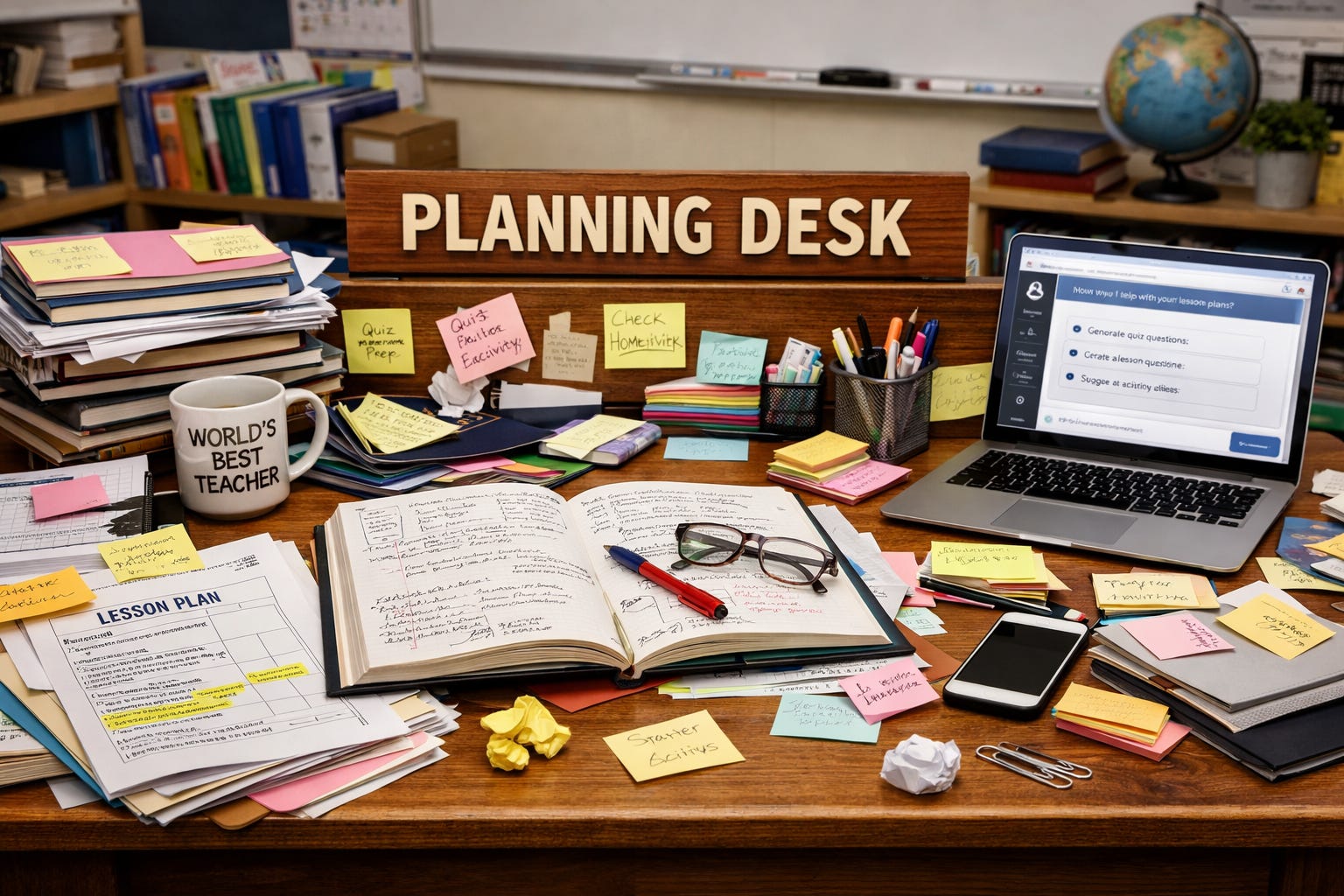
This series of posts was prompted by a talk Tom Richmond gave at researchED Cambridge last year. The talk was a follow-up to his research report “EducAItion, educAItion, educAItion: Could Generative Artificial Intelligence pose a risk to educational standards?” Part of the talk (and the report) is about how pupils’ use of AI in their learning leads to more effective performance of the immediate tasks, but less retention. This is explained in terms of cognitive offloading. This is a situation in which mental effort is reduced through the use of technology, but learning is diminished due to there being less effort. This is consistent with both cognitive psychology and empirical research. I recommend Tom’s report to anyone who wants to find out more about this. I do not dispute this aspect of the talk/report at all.
So what do I disagree with?
The talk and the report also raise the question of how this affects teachers in their use of AI. If teachers use AI in their lesson planning, they are also cognitively offloading. Are they failing to learn from their lesson planning, and will they, therefore, emerge from the process deskilled? This, in turn, raises more general questions of whether teachers can be deskilled by resources that support planning, or anything else that helps them with their work.
I take Tom’s argument seriously, but I think I should put my cards on the table first: I hate every argument about “deskilling” teachers I have ever heard. In these posts, I wish to explore my reasons for scepticism about the deskilling of teachers. Please don’t interpret these posts about deskilling as a furious, multi-part attack on Tom Richmond. They are also not an attempt to Poison the Well before addressing what he said. I think his argument avoids the traps of “deskilling” discourse in general, and none of what I am about to say in this post about the dark history of attempts to avoid deskilling applies to him. It may be some time until I actually get back to addressing his particular point.
So what is my beef about deskilling?
I have encountered “deskilling” arguments previously. I’ve encountered the arguments in both narrow and broad contexts. I strongly objected to them in both. The narrow context is the claim that teachers’ use of resources to support planning will deskill them.1 I’ve seen these arguments applied to things like scripted lesson resources, worksheets, departmental lesson planning, pre-produced curricula and the use of centrally produced workbooks. Strangely enough, I haven’t seen the deskilling argument made about asking a colleague for help, which is probably one of the most significant forms of cognitive offloading that takes place in schools. The argument is that something that reduces the time teachers spend preparing resources and planning lessons also diminishes how much teachers learn from doing their own planning. Therefore, it deskills them. I think this makes a fundamental mistake about the nature of planning.
How teachers actually plan
In reality, teachers can spend an almost unlimited amount of time preparing a single lesson if given the opportunity. Some teachers2 have spent days preparing a single lesson that was going to be observed. The planning of most lessons is never really finished; there is always more that could be done. The amount of time spent preparing a lesson is largely determined by the availability of time and how comfortable teachers are with “winging it”. This is something that strongly affects my own working life. I hate being unprepared (although I don’t mind improvising to deal with issues that emerge during the lesson). When I went part-time, the amount of time I spent preparing each lesson went way up, because I could plan lessons to my satisfaction.
The normal choice teachers face when planning is not “How long will it take to prepare this lesson?” but “How much can I half-arse this to get it done in time?” Resources that save planning time in theory, do not necessarily reduce it in practice. They often just reduce the extent of the half-arsing. They do not eliminate the thought involved in planning. Workload and thought are not the same thing. The judgements and evaluations that teachers make about their upcoming lessons, and the thoughts that are useful for learning, do not disappear because of the offloading of some of the workload. There are always many decisions to make. Even deciding what to offload is still exercising professional judgement, and is still providing an opportunity for teachers to learn. Of course, one could imagine an extreme example of a teacher who, because the resources made available to them are convenient, reduces preparation. But it’s just as easy to imagine the teacher at the other extreme, who stays up through the night preparing their lessons in tremendous detail, and is saved from this by more abundant resources. Both are being affected more by their own personal willingness to work, and their own preferences regarding half-arsing, than by the resources available.
Do we learn a lot from planning?
We should also question how much of the time spent preparing lessons is a good learning experience. How much time do teachers spend searching for resources online? Or looking for resources they think they have seen before but can’t quite find now? How much time do they spend trying to interpret badly written schemes of work to work out what resources they actually need? How much time do they spend animating PowerPoint presentations or formatting worksheets? And let’s not forget the all-time classic example of wasted planning time: filling in written lesson plans. As a teacher in the 2000s, I “off-loaded” a lot of planning tasks to an Access database I created; it did not make me a worse teacher and did not reduce the amount of time I spent on thinking about the lesson and what mattered.
I realise that I have set out the generic version of the deskilling argument. It could be the case that some resources that save time on planning (or other aspects of workload) deskill, and others don’t. Given the clear issues that workload creates for teachers, I think the burden of argument here is on those who wish to increase it. If there is beneficial workload, let them show this to be the case. From my point of view, there does not seem to be a clear principle that distinguishes deskilling resources from non-deskilling resources.3
To be continued…
In Part 2, I will discuss whether other types of workload are actually needed to avoid being deskilled.
The broader context is when the deskilling argument is applied to any support, rather than just support with lesson planning. I will look at that in Part 2.
Examples of teachers who have done this are: myself and almost every colleague I knew in the late 2000s and early 2010s.
ChatGPT suggested to me that claims about deskilling may hinge on autonomy, i.e. resources that reduce autonomy are the ones that deskill. However, I would argue that a lack of resources that increases workload also reduces autonomy. As long as we manage our time, choosing what to cognitively offload, we are acting autonomously.
ChatGPT also suggested that AI support with planning might be different to other forms of support, because it does so much. (Well, it would say that, wouldn’t it?) I will return to discussing AI and cognitive offloading in a later post.