
Deskilling Teachers Part 2
The value of experience depends on having experiences that are of value.

The story so far…
After hearing a talk that mentioned the possibility of AI “deskilling” teachers, I started looking at the argument that helping teachers with their work can “deskill” them.

Claims about deskilling
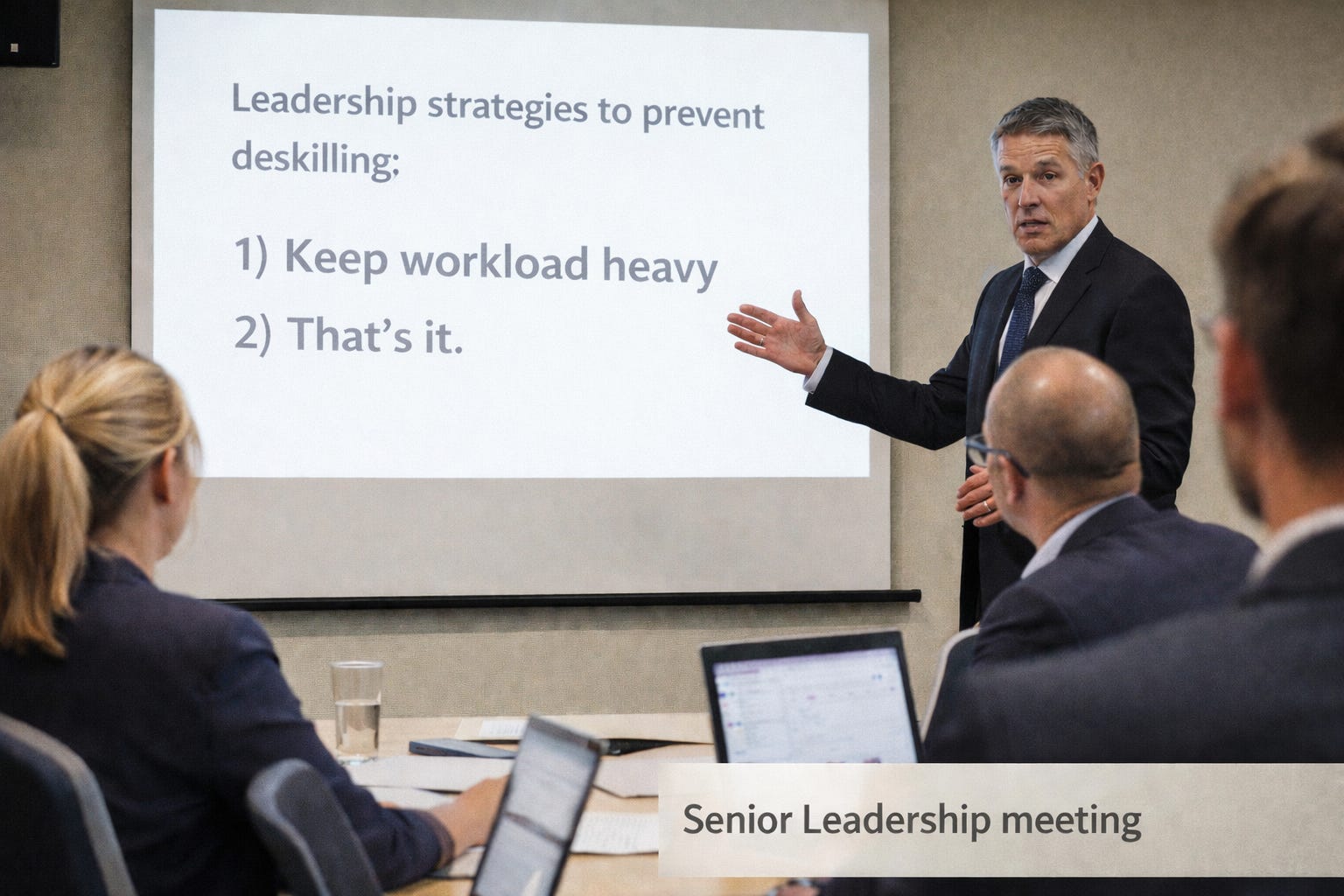
So far, I have mainly discussed planning lessons and designing resources. However, this is not the only context in which I have heard arguments about deskilling. I have also heard it claimed that teachers are deskilled by being able to remove disruptive pupils from lessons; by consistent behaviour management; by centrally designed curricula, or by teacher training that actually tells us how to teach effectively.1 Almost anything that helps us do our job and saves us effort can be condemned as deskilling. Sometimes it is implied that having an excessive workload is beneficial for teachers. If we suffer as much as possible at the start of our careers, then it is good for us. It’s almost an excuse for making the day-to-day work of teaching deliberately unpleasant. Unfortunately, in some professional bureaucracies (not just teaching), career progression is not meritocratic, and endurance is the metric for future advancement. Professionals early in their careers are given excessive work to see whether they will give up. If they don’t, then they deserve a place in the elite and will rise up the ranks. This is a disaster for teaching, because we should want to avoid a profession that consists of only the inexperienced and the ambitious. It would be best for the job of teaching full-time to be generally endurable so that experienced teachers will stay in the classroom. We do not get better managers because the system has weeded out all those who can’t survive a dysfunctional system. This is not an outcome that can be expected from having leaders who do not care whether teachers can flourish in the classroom. The main reason that “deskilling” arguments upset me is probably my experience of managers who want to break the lower ranks on the wheel of workload because that’s what it was like for them. However, you also hear variations on the professional development benefits of excessive workload from teachers who aren’t managers. Some teachers see the suffering they have endured in the classroom as some kind of personal validation. Another category of people whose claims about deskilling should be viewed with suspicion consists of those who have spent time teaching badly and now see efforts to help others teach well as an attack on their own practice. However, it has to be said that these people have often left the profession.
The value of experience
If what I have presented so far seems like a “straw man” version of the argument for deskilling, then I will point out that, in the past, I have fallen into the trap of valuing my own negative experiences. I do think my classroom experience is the main source of any professional insights I have. When teachers put forward naive views about how things should be done, I do tend to think about how I have already seen those ideas fail. However, one should never assume that the hardships one has gone through are normal or, if they are, that they are acceptable. What I have learnt the hard way may not have been learnt the best way. I will talk later in this post about how classroom experience is the most vital part of professional development, but it is not suffering that matters. If we see new teachers having an easier time than we did, we should be grateful that the madness has ended, not bitter that they won’t learn the same way we did. Workload is a huge problem for teachers, not a learning opportunity. If anything, it causes stress that reduces our learning.
Even the more moderate claims about the insights learnt from classroom experience deserve scrutiny. We must not assume that because we learnt a lesson from experience, we learnt the right lessons. Although the reality of classroom experience is the most consistently reliable filter for ideas in education, not every classroom practitioner uses it effectively.
Discovery learning versus deliberate practice
So am I claiming both to have learnt from experience and to be sceptical of the usefulness of learning from experience? Am I just contradicting myself? Maybe, but I think I can make the distinction here by referring to two pedagogical ideas: 1) discovery learning, and 2) deliberate practice.
Learning new information by discovering it is slow and inefficient for novices, and, despite true believers who still claim otherwise, it does not result in greater understanding. Much of what I learnt from experience, through discovery learning in a high-workload environment, was not learnt in the most effective way. What we learn from experience is not how to prepare a lesson, but how pupils will respond to a lesson. What we learn from experience is not the best way to manage behaviour, but the implicit knowledge of spotting problems and knowing when to switch strategies. What experience provides is not a chance to discover the basics for yourself, but an opportunity to get feedback. When you teach a lesson that doesn’t work at the time, or when, later, you assess pupils and realise they haven’t learnt the lesson content, that is where you learn how to teach better. It is a prompt to teach that content more effectively in the future. How much you learn from teaching depends on the extent to which you respond to the feedback you get in the form of pupil learning and evidence of that learning.
It’s not that we don’t learn from experience, it’s that any claim about what teachers should learn from experience should be scrutinised to see if we could learn it more effectively in other ways. Explicit instruction in the best teaching methods is the optimal preparation for novice teachers. The sink-or-swim approach of actually working everything out for yourself from first principles, through a horrific experience of being put under stress, is not an effective way to ensure teachers learn. A teacher’s development is not dependent on the amount of preparation they do beforehand or how hard they work. After teaching a lesson, you might learn that you need to spend more time preparing, or you might learn that you need to spend less time preparing. The learning teachers gain from teaching is not in proportion to the amount of workload they endured, but rather in proportion to the amount of useful feedback the experience of teaching provides.
To be continued…
In Part 3, I will look at whether using AI deskills teachers.
I wrote that while mainly thinking of arguments I have had online that I cannot easily find to cite. However, ChatGPT and Grok came up with examples of those arguments being made or referred to.