
Hackney: Ofsted and exclusions
Another interlude in the Hackney series

I have been writing about the recent safeguarding review of a school in Hackney, which demonstrated a new way to undermine schools.1 However, another development in the same borough could also make matters worse for schools. A new inspection report seems to give support to those who wish to attack schools. It also makes claims about matters of fact that are either misleading or false.
Ofsted’s inspection of SEND in Hackney
Earlier this month, Ofsted published the results of an area SEND2 inspection. This is not a school inspection, but a review of the Hackney Local Area Partnership, conducted jointly by Ofsted and the Care Quality Commission. As such, it covers health, education, and care, and examines how SEND arrangements for children and young people (aged 0–25) are delivered in the Local Authority area.
What concerns me is its approach to school exclusions in a place with a lot of activism criticising behaviour management in schools. According to the inspectors:
Too many secondary-age children have their needs identified only when they move to local authority commissioned AP. This is often after their place in their mainstream school has broken down, for example because of a permanent exclusion. Once the child is in AP, they are typically given the help that they need to prepare well for their next steps. The rate of permanent exclusions of secondary-age children with SEND in Hackney is high. Leaders fully acknowledge this. They have detailed plans in place to work with secondary schools to develop more inclusive approaches…
The rate of permanent exclusions of children and young people with SEND in secondary schools is high and has been for too long. The rate of suspensions is also high. Parents told us that some secondary schools are not identifying their child’s needs quickly and/or do not use the reasonable adjustments and/or adaptations that they should to meet their child’s needs effectively. This is also supported by evidence from the Hackney SEND information, advice and guidance service. Some children are being permanently excluded and their SEND, particularly social, emotional and mental health needs, are being identified too late. It is too early to see the impact of the partnership’s work to significantly reduce permanent exclusions over time…
Areas for improvement
Leaders across the partnership should further improve their work to develop a more inclusive approach within the local area to:
reduce the numbers of secondary-age children with SEND who are permanently excluded or suspended from school
Are exclusions in Hackney high?
Permanent exclusions in secondary schools in Hackney are high3 in the most recent annual figures. Data from the 2023/24 academic year show that the rate of permanent exclusions from Hackney secondary schools is higher than the national average, at 0.36% (i.e. 36 permanent exclusions per 10,000 pupils) compared with 0.25% for England as a whole. However, this rate varies from year to year, and those figures come from a year where Hackney happened to have the highest exclusion rate for some time.
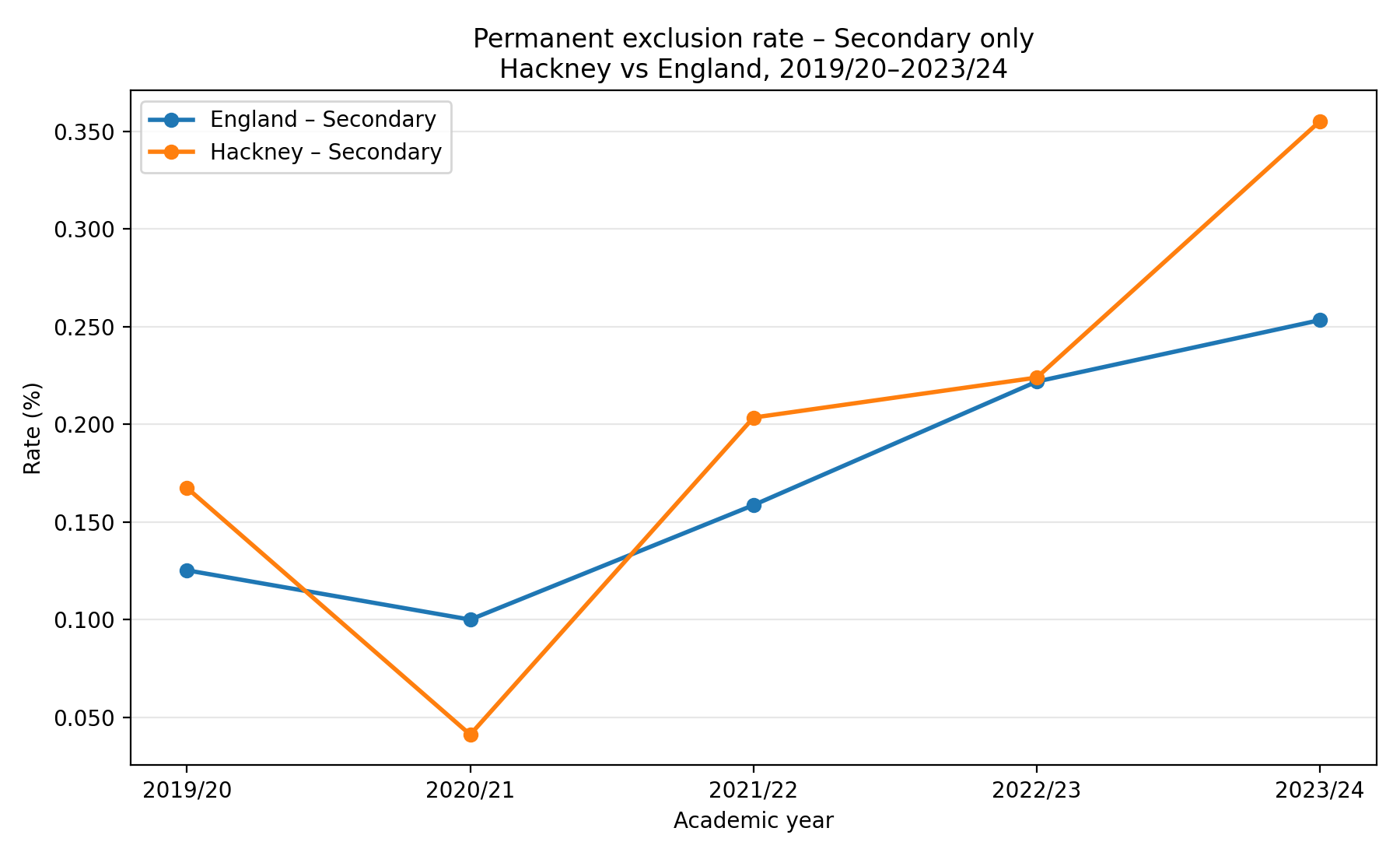
This4 does show three consecutive years of higher-than-average secondary school exclusions. So does the report have a point? I would say that this is the closest the report gets to making a valid observation about exclusions. However, this secondary-only figure gives a partial and potentially misleading picture. Why are primary schools not included in the figures? After all, excluded primary school pupils are much more likely to have SEND than excluded secondary school pupils. Looking at Hackney's exclusion data as a whole would have somewhat undercut the narrative. Although high in 2023/24, Hackney’s permanent exclusion rate has not been much different from the national average over the last few years.
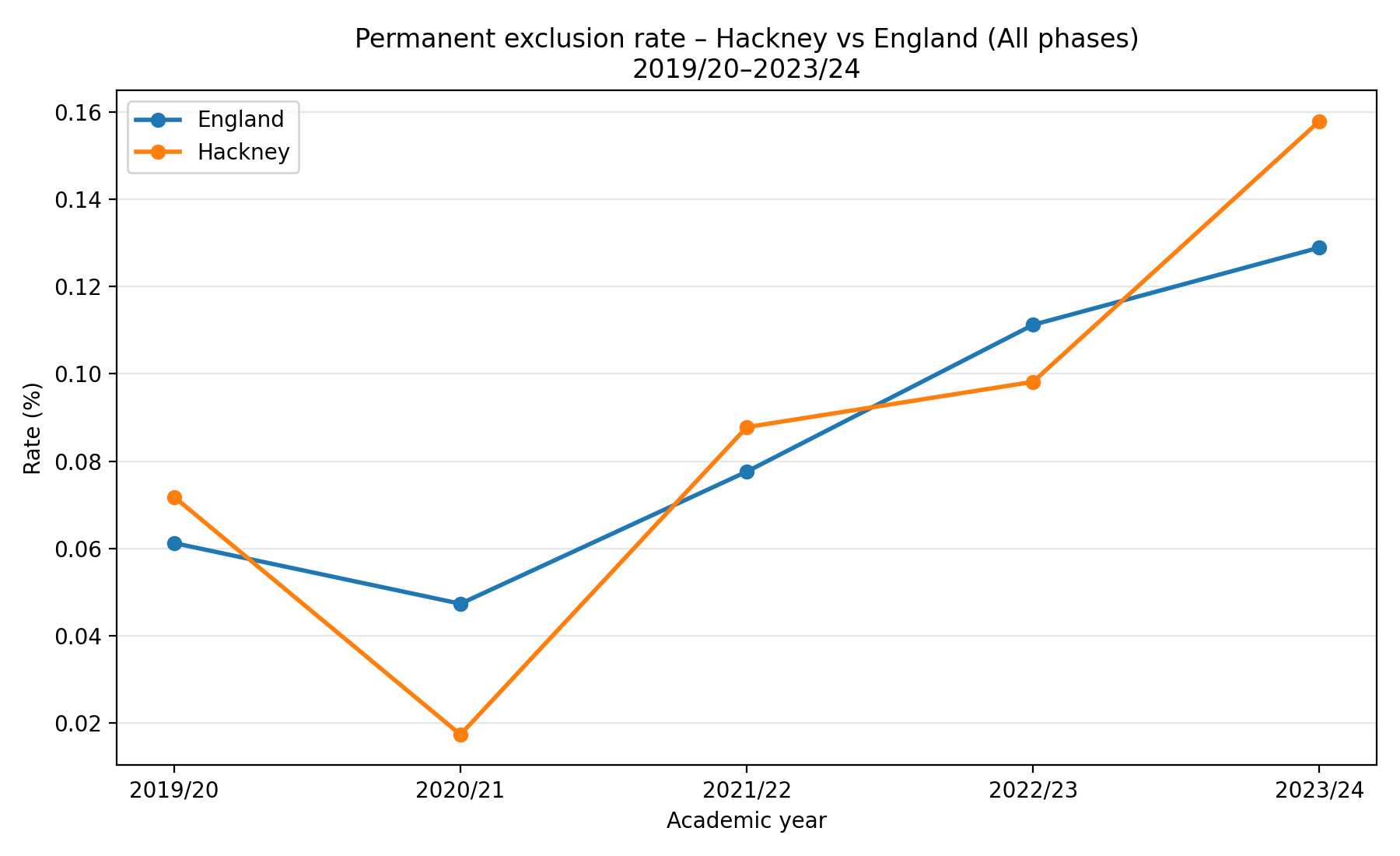
How is it possible that a Local Authority can have an unexceptional exclusion rate overall, but a high exclusion rate just for secondary schools? It’s because in the last four years of data, primary schools in Hackney have excluded no pupils at all. At this point, it seems important to note that primary schools are more likely to be maintained by the Local Authority, whereas secondary schools are typically academies. It looks like the LA (known for vocal opposition to exclusions5) has prevented permanent exclusions in primaries, which means secondary schools end up dealing with the cases that would elsewhere have led to earlier exclusion. If Hackney is (whether by accident or design) delaying exclusions until children arrive at secondary school, this doesn’t seem like it would be optimal for schools or pupils. However, rather than questioning whether this is happening, inspectors appear to imply that the only problem is that exclusions have still occurred in the end. They are encouraging the LA to interfere in secondary schools as well.
That’s misleading, but does the report say things that aren’t true?
A couple of the other claims in the report are worse than this. For instance, this one:
The rate of permanent exclusions of children and young people with SEND in secondary schools is high and has been for too long.
Unless the report is using unusual, misleading, and unstated definitions of “children and young people with SEND”,6 or of the word “high”,7 this appears to be an outright falsehood.
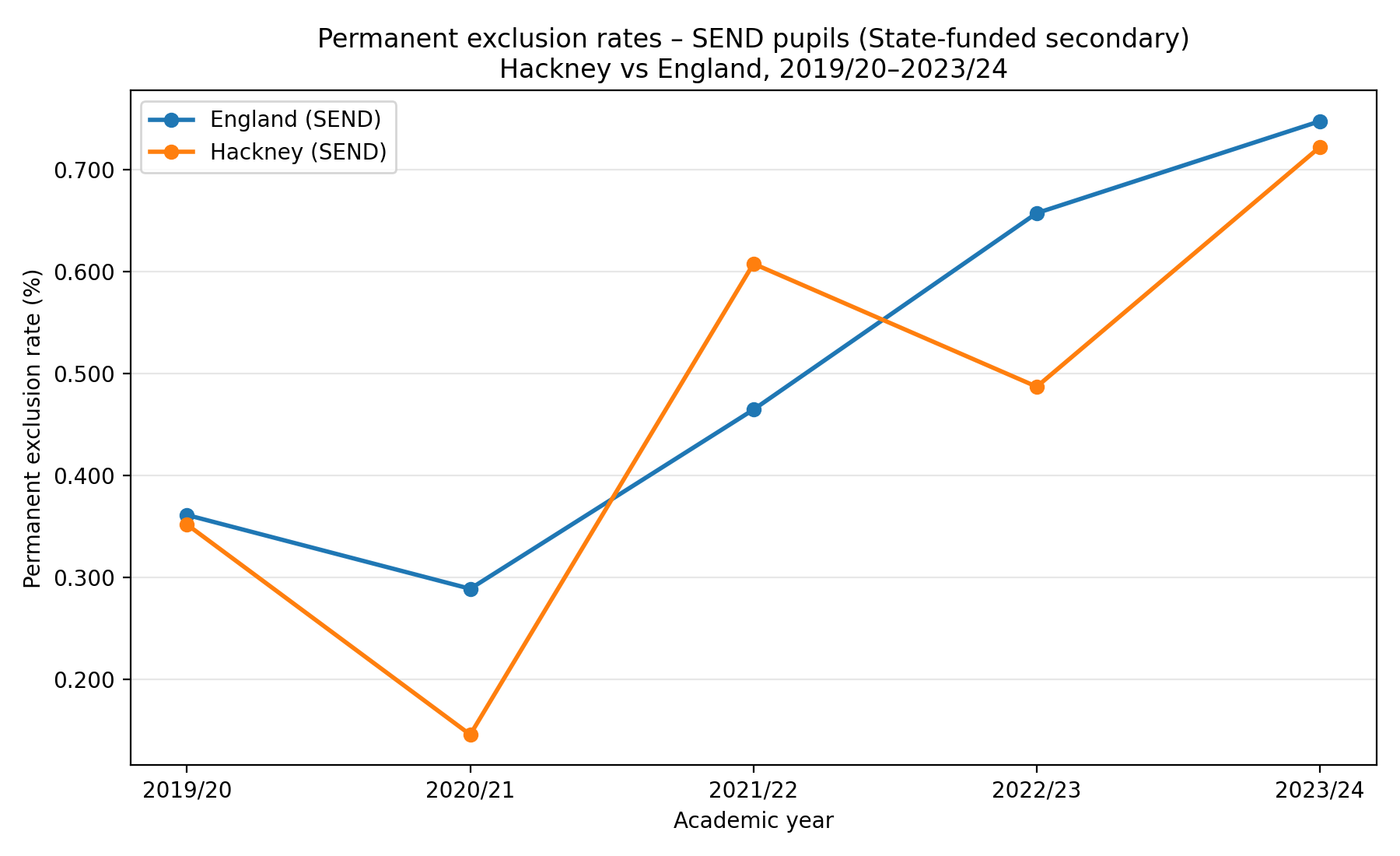
This is despite restricting the data to secondary schools. The full dataset shows that Hackney as a whole has an unusually low level of permanent exclusions for pupils with SEND, despite the report implying the exact opposite.
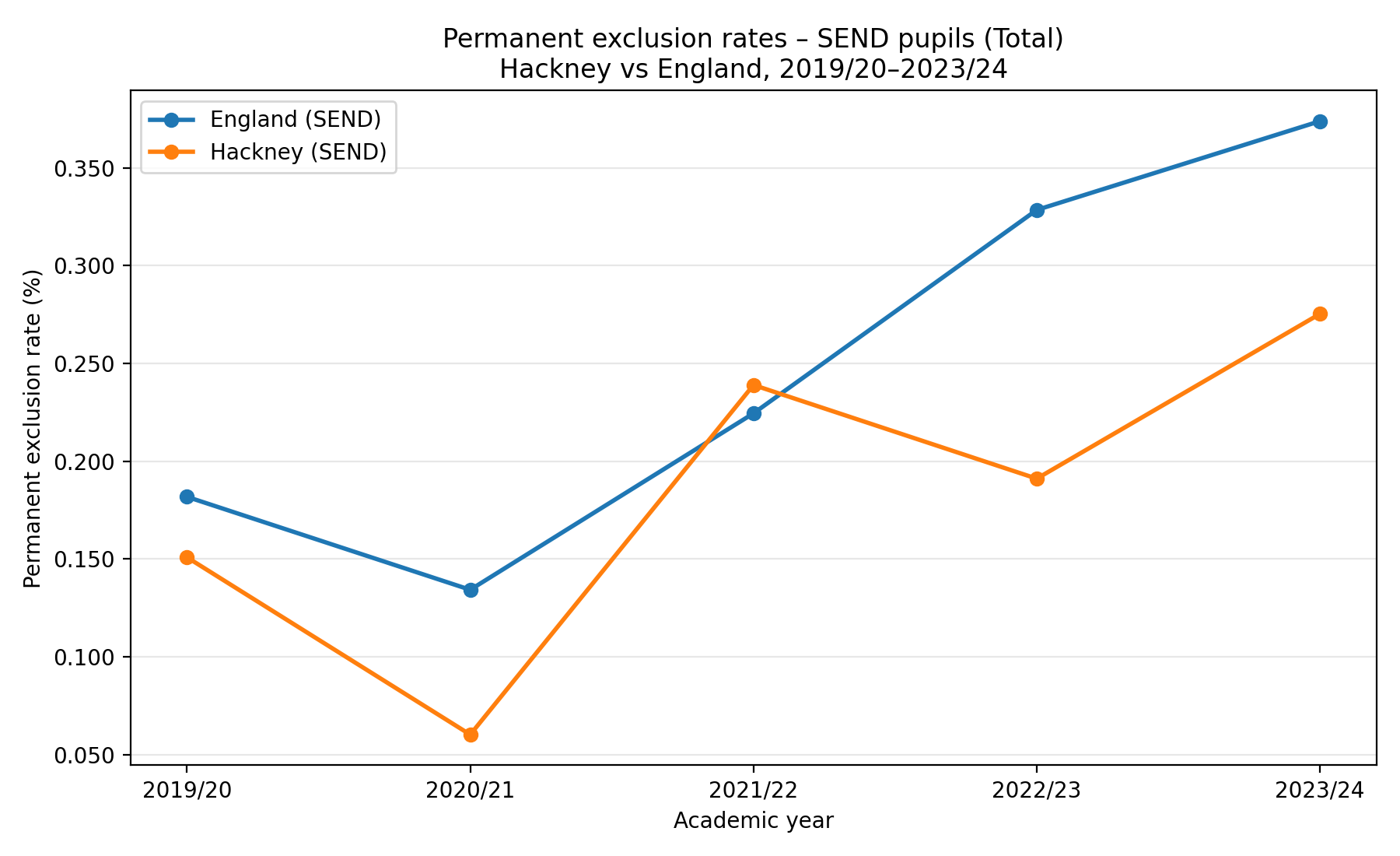
Also, according to the report, “the rate of suspensions is… high” for SEND pupils in secondary schools. Again, the reality seems to be the exact opposite:
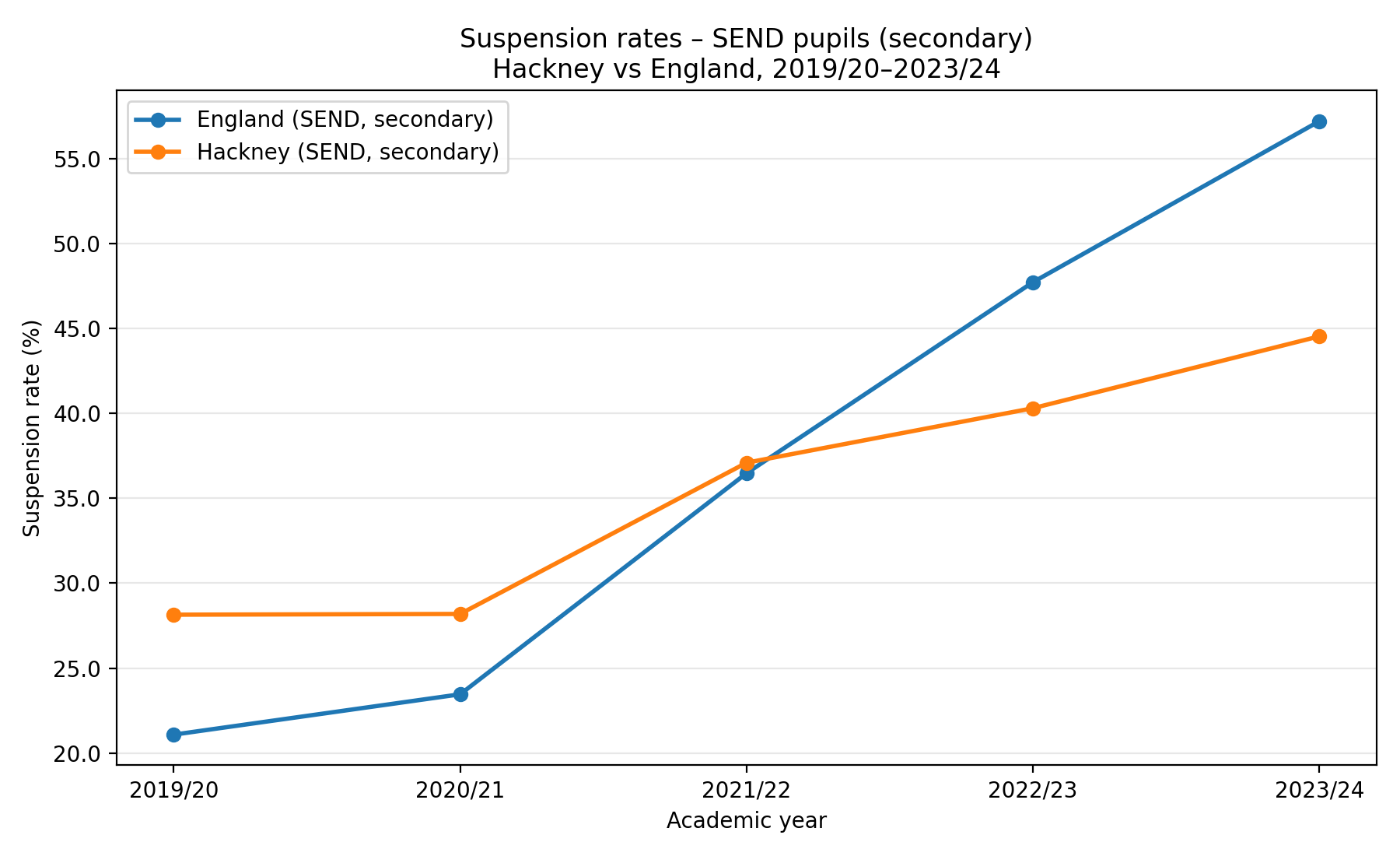
This report would be bad, even if it got its facts straight
Given the activism targeting secondary schools in Hackney, inspectors are misleading people at the worst possible time and in the worst possible place. Even if the claims about exclusions were true, I would still object to them. There are multiple reasons why inspectors should not be criticising schools in Hackney for excluding or suspending pupils with SEND.
Schools are expected to go out of their way to ensure that, if they are excluding pupils, everything possible is done to identify whether those pupils have SEND. As a result, most permanently excluded pupils are identified as having SEND at some point.
Hackney has historically had a reputation for serious youth violence, knife-enabled robbery, and crime associated with gangs. About a year and a half ago, a 15-year-old boy was fatally stabbed by another 15-year-old. Hackney also has major issues with youth poverty. In this context, who is to say that exclusions shouldn’t be higher than average?
Freeing schools from interference by Local Authorities has been a long-term aim of public policy in England for decades. Why is Ofsted encouraging local interference in secondary schools in Hackney when most have been academised?
Inclusion should not be considered a more important aim than safety. The actions schools take to protect their pupils from violence, gangs and drugs should not be overridden just because some of the worst-behaved pupils have been identified as having SEND.
I don’t know what the point of this report was, but it seems inaccurate, unhelpful and unfair.
I have written four posts about this:


Special Educational Needs and Disabilities.
Throughout this post, I use national averages to evaluate whether exclusion rates are high or not. Given that the two organisations that wrote the report operate throughout England, I think this is fair. It would be obviously misleading if they were using high to describe rates that are below the national average without a clear explanation of why. The report’s authors are perfectly happy to use comparisons with the national average when discussing attendance. It would be beyond charitable to accept that they have, without saying, adopted an unstated benchmark that informs their use of the word high when discussing exclusions.
I will acknowledge now that I have used Copilot to produce these graphs.
One possibility is that they meant to say “children and young people with EHCPs” (Education, Health and Care Plans), not “with SEND”. The exclusion rate for these pupils in Hackney secondary schools is higher than average. However, in the school context, “SEND” refers to all pupils on the SEND register. While the apparently incorrect empirical claims could be based on a mistaken interpretation of the figures, it is reasonable to assume that inspectors should not redefine SEND unilaterally.
Additionally, even if the report were corrected so that the claims about pupils with SEND explicitly referred only to those with EHCPs, they would still be misleading. Hackney does not have a high rate of exclusions for these pupils if you consider all schools. As with exclusions in general, it is misleading to focus only on secondary schools, when they are taking actions that in most LAs would have occurred earlier.
See footnote 3.
The point about students SEND needs being picked up in the PRUs caught my eye. In my experience PRUs have access to more specialists especially speech and language therapists and ed psychologists so they are able to get reports written. We have temporarily placed students with a lot of problems into PRUs to try to get them help with their behaviour problems. Often they are somewhat successful, which is likely due to the small class sizes and lots of adult mentoring and counselling and very short lessons.
In my experience when they return or go to another mainstream even with their newly diagnosed SEND they revert to old patterns and experience more detentions and suspensions.
It would be helpful if troubled students could be placed in AP without the need for a permanent exclusion. SEND or not.